


Manual transaxle
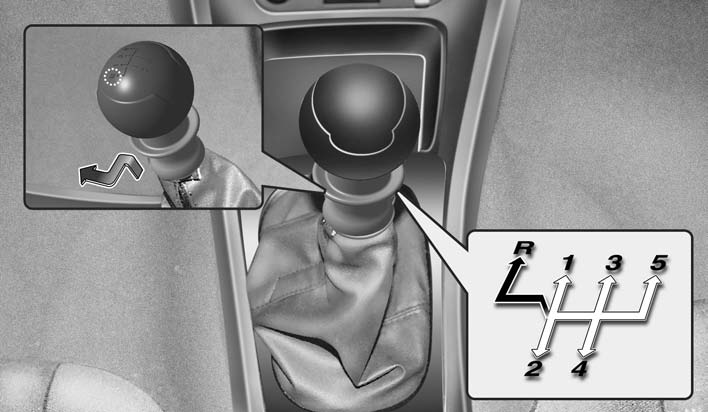
Manual transaxle operation The manual transaxle has five forward gears.
Press the clutch pedal down fully while shifting, then release it slowly.
The gearshift lever must be returned to the neutral position before shifting into R (Reverse). The ring located immediately below the shift knob must be pulled upward while moving the shift lever to the R position.
Make sure the vehicle is completely stopped before shifting into R (Reverse).
Never operate the engine with the tachometer (rpm) in the red zone.
NOTICE
When downshifting from fifth gear to
fourth gear, caution should be taken not
to inadvertently press the gear shift
lever sideways in such a manner that
second gear is engaged. Such a drastic
downshift may cause the engine speed to
increase to the point that the tachometer
will enter the red-zone. Such overrevving
of the engine may possibly cause
engine damage.
NOTICE
To avoid premature clutch wear and
damage, do not drive with your foot
resting on the clutch pedal. Also, don’t
use the clutch to hold the vehicle
stopped on an uphill grade, while waiting
for a traffic light, etc..
WARNING - Manual
transaxle
Before leaving the driver’s seat,
always set the parking brake fully
and shut the engine off. Then make
sure the transaxle is shifted into 1st
gear when the vehicle is parked on
a level or uphill grade, and shifted
into R (Reverse) on a downhill
grade. Unexpected and sudden
vehicle movement can occur if
these precautions are not followed
in the order identified.
Downshifting
When you must slow down in heavy traffic
or while driving up steep hills, downshift
before the engine starts to labor.
Downshifting reduces the chance of stalling and gives better acceleration when you again need to increase your speed. When the vehicle is traveling down steep hills, downshifting helps maintain safe speed and prolongs brake life.
See also:
Windshield defrosting and defogging
Manual climate control system
To defog inside windshield
1. Select any fan speed.
2. Select desired temperature.
3. Select the or position.
4. The outside (fresh) air and air conditioning
will ...
If the engine overheats
If your temperature gauge indicates overheating,
you experience a loss of power,
or hear loud pinging or knocking, the
engine is probably too hot. If this happens,
you should:
1. Pull off the roa ...
Powertrains and Performance
The 2010 Kia Sportage can be had with one of two engines and a choice of
front- or all-wheel drive. LX base models get a 2.0-liter four-cylinder that
puts out 140 hp and 136 pound-feet of torque. ...