


Hood
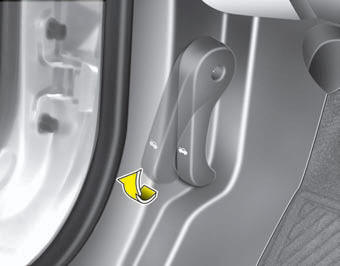
Opening the hood
1. Pull the release lever to unlatch the
hood. The hood should pop open
slightly.
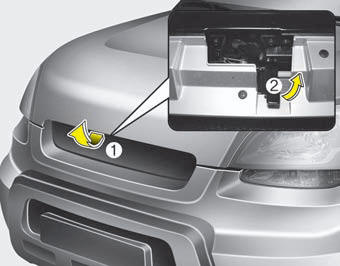
2. Go to the front of the vehicle, raise the hood slightly, pull the secondary latch inside of the hood center and lift the hood.
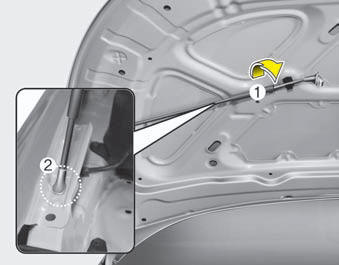
3. Pull out the support rod from the hood.
4.Hold the hood open with the support rod.
WARNING - Hot parts
Grasp the support rod in the area
wrapped in rubber. The rubber will
help prevent you from being burned
by hot metal when the engine is
hot.
Closing the hood
1. Before closing the hood, check the following:
• All filler caps in the engine compartment
must be correctly installed.
• Gloves, rags or any other combustible material must be removed from the engine compartment.
2. Return the support rod to its clip to prevent it from rattling.
3. Lower the hood until it is about 30 cm (1 ft.) above the closed position and let it drop. Make sure that it locks into place.
WARNING
• Before closing the hood, ensure
that all obstructions are removed
from the hood opening. Closing
the hood with an obstruction
present in the hood opening may
result in property damage or
severe personal injury.
• Do not leave gloves, rags or any other combustible material in the engine compartment. Doing so may cause a heat-induced fire.
WARNING
• Always double check to be sure
that the hood is firmly latched
before driving away. If it is not
latched, the hood could open
while the vehicle is being driven,
causing total loss of visibility,
which might result in an accident.
• The support rod must be inserted completely into the hole provided whenever you inspect the engine compartment. This will prevent the hood from falling and possibly injuring you.
• Do not move the vehicle with the hood raised. The view will be blocked and the hood could fall or get damaged.
See also:
2011 Kia Optima Review
The previous generation Kia Optima was a vehicle struggling to keep up with
the times, having emerged on the scene as a lackluster model masquerading as a
value proposition, when in reality it was ...
Maintenance schedule
Chart symbols:
I- Inspect these items and their related parts. If necessary, correct, clean,
refill, adjust or replace.
R- Replace or change
L- Lubricate.
(1) Refer to the lubricant and co ...
Exterior feature
Roof rack (if equipped)
If the vehicle has a roof rack, you can
load cargo on top of your vehicle.
NOTICE
If the vehicle is equipped with a sunroof,
be sure not to position cargo onto the
roof ...